Starting a private label skincare line no longer needs your own laboratory or production line. Most new brands work with an OEM supplier: you decide the product, the brand and the packaging, and the supplier produces it with a manufacturing partner. This guide walks through the whole route for a brand selling in the UK or the EU, from the first idea to the first carton on your shelf.
What does an OEM supplier actually do for a skincare brand?
An OEM (original equipment manufacturer) supplier produces finished cosmetics that are sold under your brand. You own the brand name, the artwork and the market; the supplier handles formulation, filling, packaging and shipping. If you are unsure which model fits you, read OEM vs ODM vs private label.
There are usually two ways to work:
| Route | What you provide | Best for |
|---|---|---|
| Custom OEM | Your own design: artwork, packaging drawings, a reference sample or a detailed brief | Brands that already know exactly what they want |
| Formula development | A description of the product type, the effect and texture you want, and a target price | Brands that want a new formula made for them |
At Cosmebatch both routes are available; see how our OEM process works.
Step 1: Define the product before you ask for a quote
The clearer your brief, the more accurate the quotation. Before contacting any supplier, write down:
- Product type and function – for example a hydrating serum, a gel moisturiser for oily skin, or a body balm.
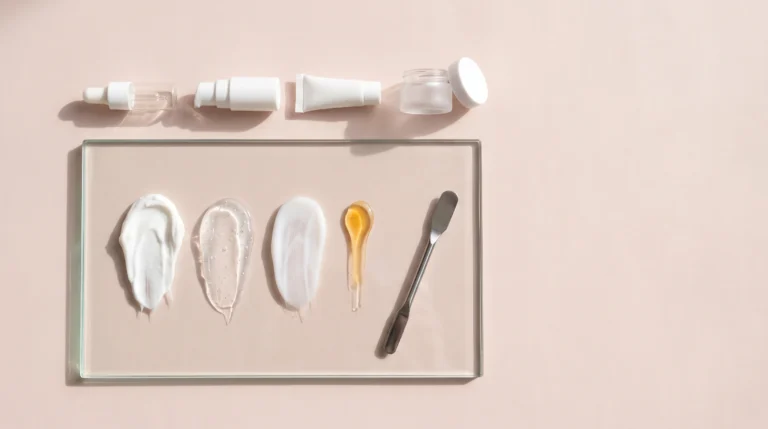
- Texture and finish – light gel, rich cream, matte or dewy.
- Key ingredients or claims you want – every claim must be supported by evidence when you sell in the UK or EU.
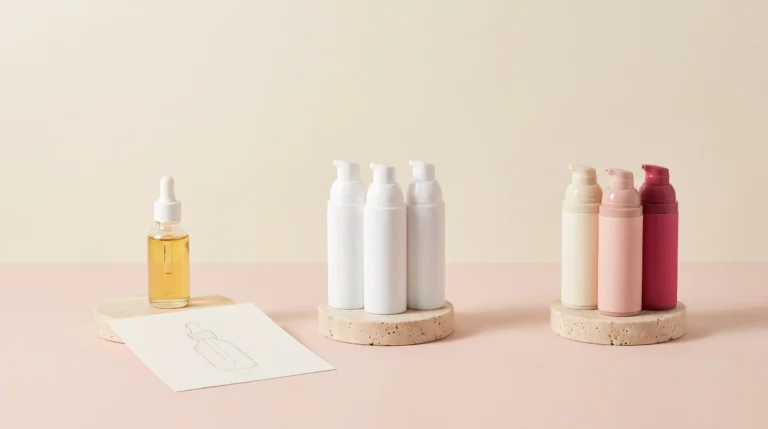
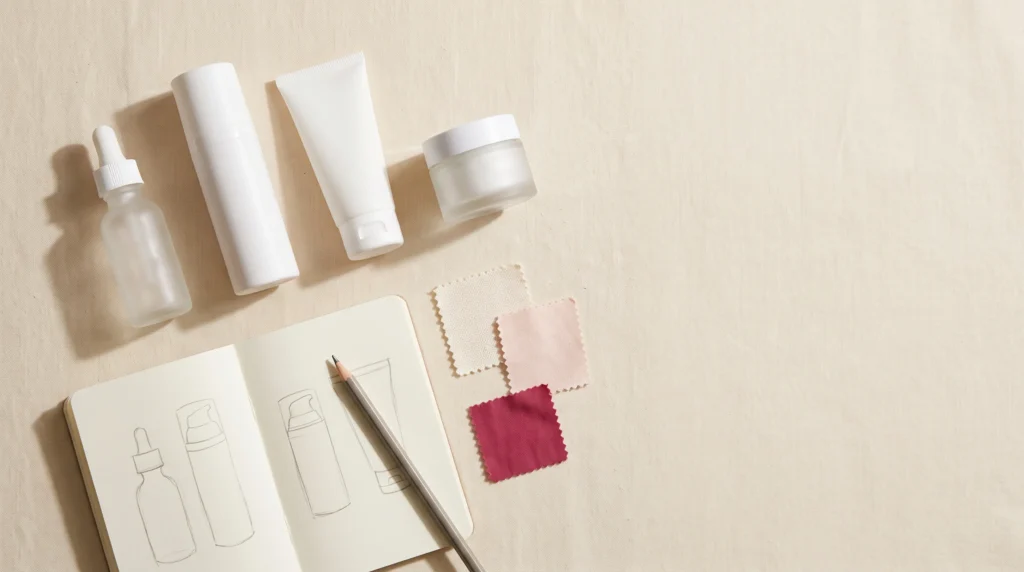
- Packaging – pump bottle, tube, dropper bottle, jar, and the volume. Our skincare packaging guide compares the options.
- Quantity per product and per variant.
- Target price and destination country.
Reference photos or a sample of a product you like help a lot. You only send your own brand name and artwork: a reputable supplier will not copy another company’s brand, logo or packaging design, and you should not ask for it.
Step 2: Understand MOQ before you plan your budget
The minimum order quantity (MOQ) is the smallest quantity a supplier will produce per product. Traditional factories often ask for several thousand units per item, which ties up a lot of cash for a new brand.
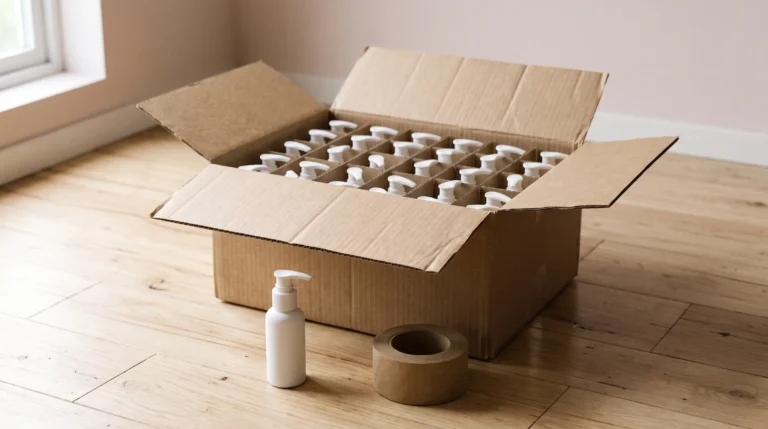
Lower MOQs let you test the market with less risk. At Cosmebatch the minimum order is 144 pieces (one carton) per product, so you can launch a small range and reorder what sells. When you compare suppliers, check whether the MOQ applies per product, per colour or per packaging design, because this changes the real starting quantity. More in what a realistic MOQ looks like.
Step 3: Read the quotation carefully
A quotation should list everything that affects your landed cost. Look for:
- Unit price and the quantity it is based on
- Packaging and printing included or charged separately
- Sample cost and what happens to it when you place a bulk order
- Production lead time
- Shipping method and cost, and who pays import duties
- Payment terms (deposit and balance) and accepted payment methods
Cosmebatch sends a quotation sheet by email covering these points for your product and quantity, and accepts wire transfer, credit card and PayPal. See how to read a cosmetics OEM quotation for a line-by-line checklist.
Step 4: Approve a sample before production
Never go into bulk production without approving a physical sample. Test the texture, scent, packaging function (does the pump work, does the tube seal) and how the product performs over a few weeks.
At Cosmebatch a sample costs US$20, international shipping included, and the fee is credited in full against your first bulk order of one carton or more of any product placed within 90 days. Production follows the sample and specification you approve. Read how cosmetic samples work for a testing checklist.
Step 5: Make the product legal to sell in the UK and EU
This is the step new brands most often underestimate. The supplier makes the product, but placing it on the market is your legal responsibility as the brand owner or importer.
Great Britain (England, Scotland, Wales)
- Every product needs a Responsible Person with a UK address. This can be the importer, the brand owner, or a company appointed to act for you.
- The Responsible Person must keep a Product Information File (PIF), including a safety assessment carried out by a qualified safety assessor.
- The product must be notified to the Office for Product Safety and Standards (OPSS) through the Submit Cosmetic Product Notification (SCPN) service before it is made available to consumers.
- Northern Ireland follows EU rules, so it needs a Responsible Person in Northern Ireland or the EU.
Full details: selling cosmetics in the UK.
European Union, including Spain
- The EU Cosmetics Regulation (EC) No 1223/2009 applies. You need a Responsible Person established in the EU.
- The PIF and safety report must be kept by the Responsible Person, and the product must be notified on the Cosmetic Products Notification Portal (CPNP) before it goes on sale.
- In Spain, the competent authority is the AEMPS. Royal Decree 85/2018 requires key label information – such as nominal content, durability date, precautions and the product’s function – to appear in Spanish, and companies that import cosmetics from outside the EU must file a declaración responsable with the AEMPS before they start.
Full details: selling cosmetics in the EU and Spain.
What must be on the label
| Label item | Example |
|---|---|
| Name and address of the Responsible Person | Your company or your appointed RP |
| Country of origin (imported products) | Made in the country of origin |
| Nominal content | 50 ml |
| Date of minimum durability or period after opening | Open-jar symbol with “12M” |
| Precautions for use | “Avoid contact with eyes” |
| Batch number | Printed on the pack |
| Function of the product | “Hydrating face serum” |
| Ingredients list (INCI names) | Aqua, Glycerin, Niacinamide… |
Plan your artwork with this list from the start, so you do not have to reprint packaging. Ask your supplier for the full ingredients list and the documents your safety assessor needs. Our cosmetic label requirements guide covers each item in detail.
Step 6: Production, shipping and import
Once the sample and artwork are approved and payment terms are agreed, production starts. The lead time is confirmed in your quotation and depends on the product, the packaging and the quantity; see what affects OEM lead times.
From China, goods usually travel by courier (fastest, for smaller orders), air freight, or sea freight (lowest cost per unit for larger orders). Cosmebatch chooses a suitable carrier for each shipment, or ships to your own freight forwarder. Import duties, taxes and customs clearance in your country are paid by the buyer, so include them in your landed cost. Compare the options in shipping cosmetics from China, and see the import guides for the UK and Spain.
How much does it cost to start a skincare line?
There is no single number, but the budget always has the same parts:
- Samples
- First production order (MOQ × unit price for each product)
- Packaging design and printing
- Safety assessment and Responsible Person services
- Shipping, import duties and VAT
- Marketing and your sales channel
A low MOQ mainly reduces item 2, which is usually the largest single cost for a new brand.
Checklist: launching your skincare line
- Write a product brief (type, effect, texture, packaging, quantity, target price).
- Request quotations and compare MOQ, sample terms and lead time.
- Order and test samples.
- Appoint a Responsible Person for each market you sell in.
- Get the safety assessment and build the PIF.
- Finalise compliant label artwork.
- Place the bulk order and arrange shipping.
- Notify the product (SCPN for Great Britain, CPNP for the EU) before selling.
Ready to start? Browse our skincare OEM range for packaging and formula ideas, or send us your brief.
Sources
- GOV.UK – Making cosmetic products available to consumers in Great Britain
- GOV.UK – Submit a cosmetic product notification
- EUR-Lex – Regulation (EC) No 1223/2009 on cosmetic products
- European Commission – Cosmetic Products Notification Portal (CPNP)
- BOE – Real Decreto 85/2018 on cosmetic products (Spain)
- AEMPS – FAQ on the declaración responsable for cosmetics manufacturers and importers
This guide is general information, not legal advice. Regulations change; check the official sources above or a regulatory consultant before you sell.